


Applying AI as an operating lever in private equity
The following article was contributed by Ari Klinger, Founder and Managing Director of No Brand Holdings.
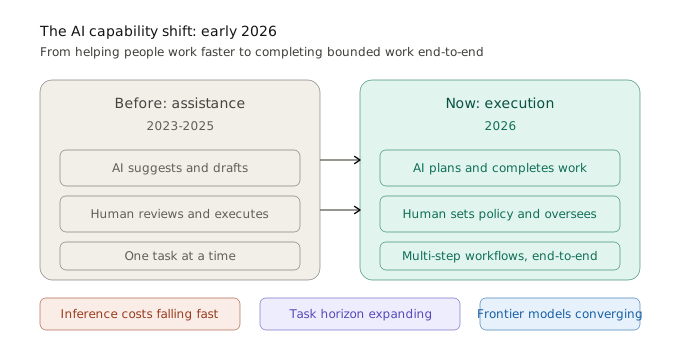
Something shifted in AI in early 2026. For the first time, AI systems can reliably complete bounded work end-to-end.
This matters for anyone investing in or through private equity. BCG’s January 2026 survey of senior PE investors points to a meaningful performance gap between companies building AI capabilities systematically and those that are not. AI is increasingly moving beyond post-close efficiency projects toward a more systematic role in value creation, and firms that treat it as an operating capability may be better positioned over time.
What changed
For the past few years, AI has been primarily an assistant. You asked it a question, it gave you a draft, and a human took it from there. Useful, but incremental.
In early 2026, AI crossed a practical threshold in certain domains. It started moving from accelerating work to completing work. Today’s AI “agents” can plan a multi-step workflow, execute it across tools and systems, and hand back a completed result. In the better-bounded workflows, the human increasingly sets policy, reviews exceptions, and stays accountable for the outcome rather than completing every step manually. The cost of running these systems fell at the same time, and frontier models have continued to improve rapidly, compressing the gap between what’s possible in a lab and what’s deployable in a business.
This is not uniform across every sector or workflow. The earliest gains are showing up where work is repetitive, measurable, software-enabled, and bounded. But in those areas, smaller teams can now operate with a level of output that was previously impractical, and it’s starting to show up in portfolio company operating metrics.
Why this matters for PE portfolios
Many PE firms have been investing in digital and operating capabilities for years. What’s changed is that AI is becoming a more practical and measurable part of that toolkit. Vista Equity Partners has described building a centralised “agentic factory” to deploy AI capabilities across its enterprise software portfolio. A growing number of its portfolio companies are already monetising AI-powered features. One example cited publicly is Duck Creek Technologies, where AI is being applied to underwriting workflows in ways that shift value from seat-based software toward more outcome-oriented delivery.
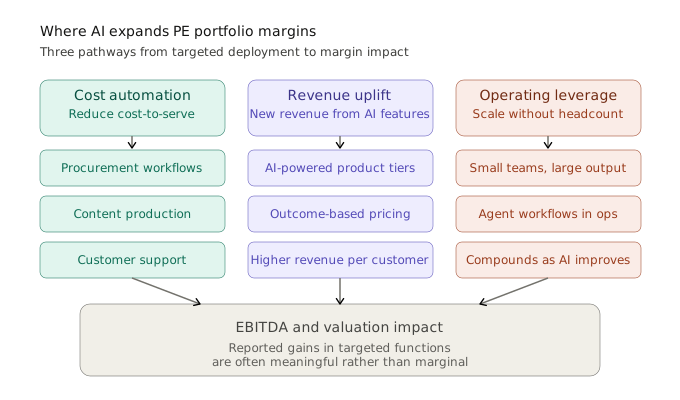
Apollo Global Management has reported targeted operational gains from AI in areas such as procurement, content workflows, and lead generation. Measured improvements are beginning to show up in specific functions where workflows are repetitive and measurable.
These are large funds with dedicated resources. But the underlying principles apply at smaller scale. The cost of deploying AI has fallen far enough that mid-market managers can start with targeted use cases in customer support, financial reporting or procurement without building a centralised factory. What matters is whether it’s approached systematically and tied to measurable outcomes.
In the public case studies, reported gains in targeted functions are often meaningful rather than marginal. Not blanket headcount reductions, but margin gains in specific parts of the business where AI can complete the work reliably enough to warrant deployment.
Only a small percentage of PE portfolio companies have reached enterprise-scale AI deployment so far. The large majority of funds report AI initiatives meeting or exceeding the original business case, but most of those cases were conservatively scoped. The broader value opportunity appears to remain ahead, in part because most deployments are still narrow rather than enterprise-wide.
How to consider AI in PE allocation
For investors building or evaluating a private equity portfolio, AI capability is increasingly showing up in operational performance.
- Timing matters. Digital transformation integrated into value creation planning from the start tends to deliver stronger results than initiatives layered on after acquisition. When AI is built on mature digital foundations, the returns and time-to-value both appear to improve materially.
- Whether AI is treated as a system or a collection of experiments also matters. Well designed deployments are systematic, not one-off. The difference between a coordinated operating approach and ad hoc experimentation by individual management teams tends to compound over time.
- Many funds can tell you how many portfolio companies are “using AI.” Fewer can tell you the margin impact. The ones that can are the ones treating it as an operating discipline, and that discipline is increasingly relevant to how portfolio outcomes diverge.
For investors, the question is becoming less whether AI will matter in PE, and more which managers are building the operating discipline to apply it well.
Ari Klinger is the founder and managing director of No Brand Holdings, a private investment company. Ari built and exited three technology companies before moving into investing, where he has backed more than 50 companies, including HotDoc, Hipages, Kami and Ignition.
Selected Sources: BCG, “Private Equity’s Future: Digital First and AI Powered” (Jan 2026). CNBC, “Vista Equity Partners says its ‘agentic factory’ is reinventing the way companies use AI” (Jan 2026). MIT Sloan Management Review, “Building AI Capabilities Into Portfolio Companies at Apollo” (Jun 2025). FTI Consulting, “2026 Private Equity AI Radar” (Mar 2026). ARK Investment Management, “Big Ideas 2026” (Jan 2026).